
Hamilton County Sex Offender Checks
The Tennessee Sex Offender Registry, maintained by the Tennessee Bureau of Investigation, is the authoritative public source for a Hamilton County sex offender lookup. It supports name and geographic searches. Hamilton County law enforcement performs local registration and verification work, while TBI publishes the statewide public view. These roles matter. A local agency can take a compliance report, but the TBI portal is the place to read the current public profile.
Start with the narrowest reliable identifier. An offender ID is stronger than a name alone. When only a name is known, compare aliases, photograph, physical details, status, offense rows, and the agency attached to an address. A Hamilton County result may have more than one address or reporting agency. Never assume the first similar name is the correct person. Registry information is not a general Hamilton County criminal-history report, and it should not be read as one.
Map Hamilton County Registry Records
The Hamilton County registry's geographic interface searches near an address and can display results in a list or map. Enter a verified location, confirm the map pin, and keep the viewport in mind when reading what appears. A Hamilton County map can help with community awareness, yet it represents public registry addresses rather than a live measure of where someone is at each moment.
The official TBI registry entry screen shows the proper statewide starting point for a Hamilton County search.
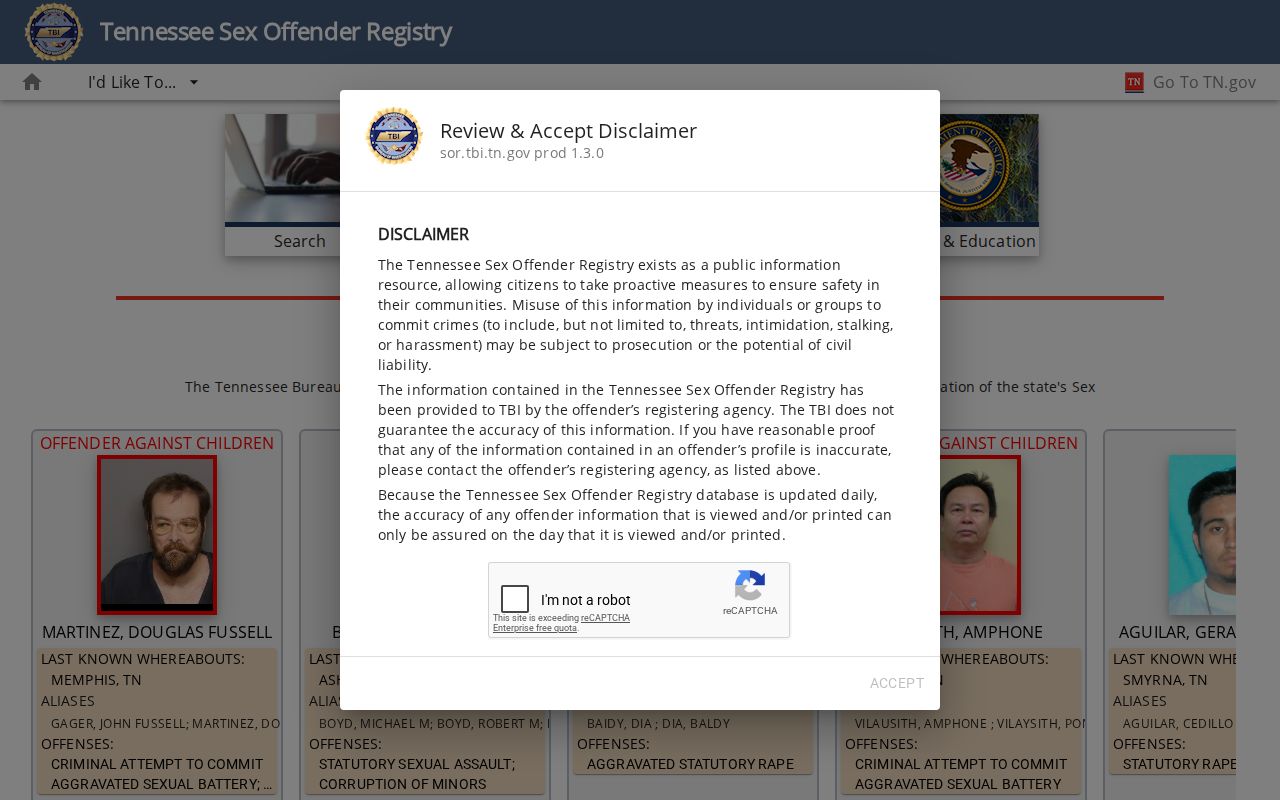
That screen keeps the Hamilton County search tied to TBI data and its conditions of use. For an address search, use the separate map control, verify the candidate pin, and open each profile before drawing a conclusion. A Hamilton County marker alone lacks the status, responsible agency, offense context, and reporting details needed to understand an entry.
Tennessee Sex Offender Registry Searches
A Hamilton County registry search works best as a short, careful sequence. TBI offers several inputs, so a missed name need not end the search. Spelling, aliases, movement between counties, and current status can change what a single query returns.
- Open the TBI registry and review its conditions of use before searching.
- Search by last name with a first name when known, or use the offender ID for a direct match.
- Select Hamilton in the county field, or use city, ZIP, and map controls for a place-based check.
- Open the possible profile and compare the photograph, aliases, status, address, responsible agency, and offense rows.
| Search control | Use | Key point |
|---|---|---|
| First Name | Optional name detail | Helps narrow a common last name |
| Last Name | Principal name input | Check exact name and known alias issues |
| Offender ID | Direct identifier | Best when the registry number is known |
| County | Geographic filter | Select Hamilton for county results |
| City or ZIP | Local narrowing | Use in the applicable geographic view |
| Address or map location | Proximity search | Confirm that the map pin is correct |
Compare Hamilton County Registry Results
TBI is the right source for Tennessee details. The National Sex Offender Public Website, operated by the U.S. Department of Justice, adds a cross-state and tribal search layer. Use it when a person may have lived outside Tennessee, when a move is recent, or when the relevant place crosses a state line. NSOPW gathers participating public registries; it does not replace the state agency that owns and updates the underlying record.
The national search interface illustrates how a Hamilton County inquiry can widen beyond Tennessee without turning to a commercial people-search product.
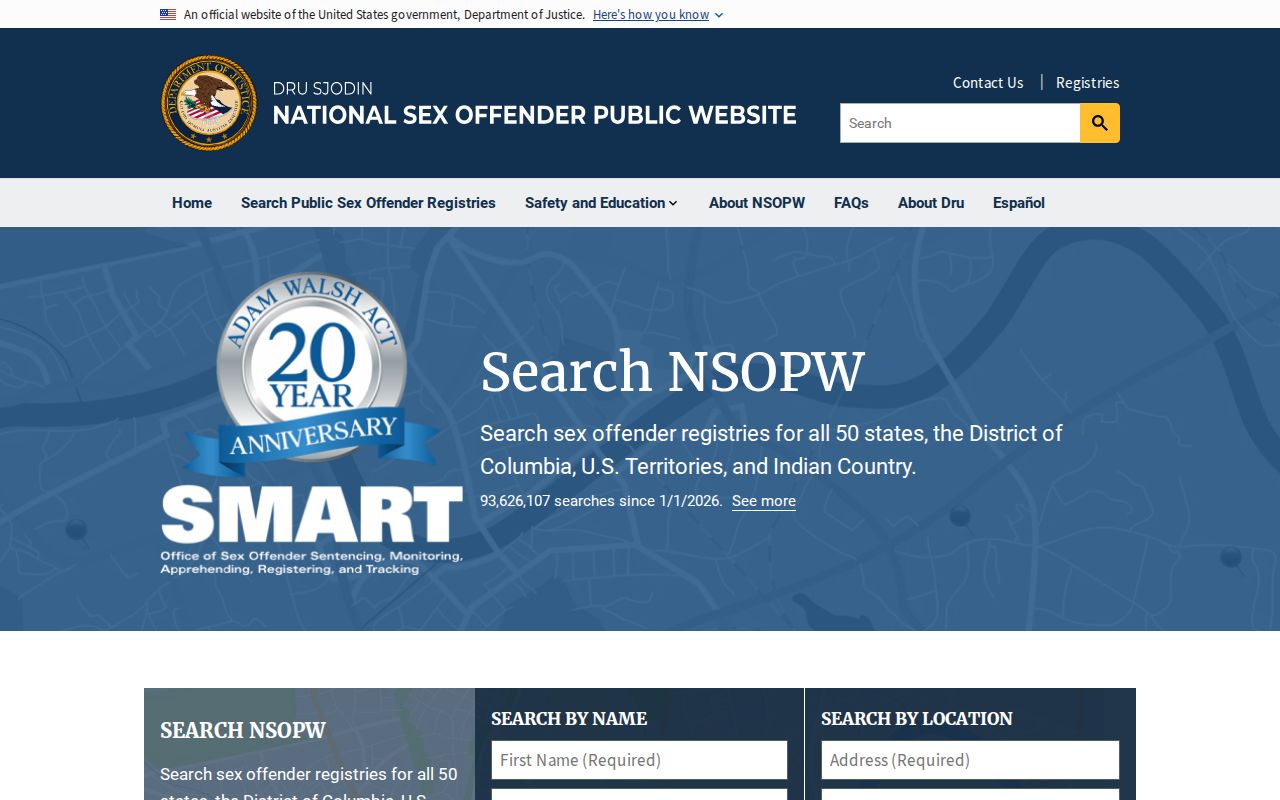
When the two systems differ, return to the source registry named in the result. Compare identifiers and status, then contact that registry or its responsible law-enforcement agency. A difference can reflect timing, classification rules, a move, or a source-system update rather than proof that either similar name is the correct person.
Registry Profiles: What They Show
A Hamilton County public profile joins several kinds of information that should be read together. Some fields vary by person and legal status, so do not treat every possible field as universal. Hamilton County entries may show more than one address record or agency, and the offense panel may contain both a charge description and a disposition.
| Identity | Registry identifier, name, aliases, photograph, and public physical descriptors |
|---|---|
| Classification | Sexual offender or violent sexual offender classification and current status |
| Reporting | Last-reporting agency, report type, and available verification information |
| Addresses | Public primary or secondary address records and the responsible agency |
| Offense History | Offense date, charge, disposition, and a statutory explanation when provided |
| Other Public Details | Work, school, vehicles, and scars, marks, or tattoos when the law makes them public |
A photograph and address help distinguish people, but neither converts a registry entry into a forecast. Check the classification, status, offense date, disposition, and reporting agency as well. If a legal outcome is the real question, the originating court file is the better source for pleadings and final orders.
Read Hamilton County Registry Status
Hamilton County status labels answer different questions. Active generally means the person remains in an active reporting category. Absconder signals a compliance concern recorded by the registry. Inactive may reflect incarceration, deportation, death, movement to another state, or a juvenile classification, depending on the full label. An inactive label does not erase the historic basis for the entry.
- Annual Sexual Offender
- A last-report type tied to the annual verification pattern for a sexual offender.
- Quarterly Violent Offender
- A last-report type tied to the more frequent verification pattern for a violent sexual offender.
- Information Updated
- A report showing that required public information changed outside the regular cycle.
- Absconder
- A registry status indicating an identified failure to maintain required compliance.
Read the complete phrase, not just the first word. Hamilton County residents who need official clarification should use the agency identified on the profile or call local law enforcement. Immediate danger belongs with 911, not a database inquiry.
Registration Levels and Duties in Tennessee
Tennessee does not use a simple public three-tier chart for Hamilton County records. Its key distinction is between sexual offenders and violent sexual offenders, with extra lifetime rules tied to multiple qualifying convictions and victims under thirteen. Out-of-jurisdiction and juvenile matters have separate timing provisions. The table preserves those differences rather than forcing them into generic tier labels.
| Classification or circumstance | Duration | Verification |
|---|---|---|
| Sexual offender, otherwise not lifetime | May request termination ten years after sentence expiration, subject to TBI review | Annual reporting reflected in TBI help |
| Violent sexual offender | Lifetime; ordinary ten-year termination does not apply | Quarterly reporting reflected in TBI help |
| Two or more qualifying convictions | Lifetime | As required by classification |
| Victim under thirteen | Lifetime under TBI guidance | As required by classification |
| Out-of-jurisdiction registrant | At least ten years after sentence expiration or five years after entering Tennessee, whichever is later | Depends on Tennessee classification |
| Juvenile registry matter | Separate termination rules | Do not apply adult shorthand |
Required changes can trigger an update between scheduled reports. Tennessee Code sections 40-39-201 through 40-39-213 govern the program, including registration content, termination, expungement-linked removal, and residence or presence restrictions.
Section 40-39-211 contains Tennessee's residence and presence limits. Those rules turn on the person's classification, the kind of location, and the facts, so a map pin should not be used to make a legal conclusion. Send a concrete Hamilton County compliance concern to the responsible law-enforcement agency shown in the profile. The agency can compare the reported address and duty status with information that is not available from a public map alone.
Hamilton County Registry Removal Requests
The ten-year mark does not automatically remove a Hamilton County entry. Under TBI guidance, an otherwise eligible sexual offender may request termination ten years after the sentence expires. TBI then reviews whether another qualifying offense exists and whether the person substantially complied. Violent sexual offenders and people within listed lifetime circumstances do not use that ordinary route.
A qualifying expungement order can affect a registry record under Tennessee Code section 40-39-209, but an expungement request and a registry termination request are not interchangeable. The court order, offense classification, and statute control. Hamilton County court records should be used to confirm the actual disposition before anyone assumes a registry listing must disappear. Juvenile cases also follow their own termination provision under section 40-39-207.
Note: Reaching ten years permits an eligible request and review; it does not cause the Hamilton County registry entry to vanish by itself.
Report Hamilton County Registry Concerns
TBI directs a person who believes someone is unregistered or noncompliant to local law enforcement. In Hamilton County, call the Hamilton County Sheriff's Office at 423-209-7000, or use the responsible local agency shown on the profile. Give the agency the registry identifier, exact public status, location concern, and the reason for the report. Do not confront, follow, threaten, or publish personal claims about the registrant.
If the issue is a suspected Hamilton County data mistake rather than noncompliance, identify the field that appears wrong and the profile's responsible agency. That makes the inquiry easier to route. Use 911 only for immediate danger. The registry search itself is not an emergency-reporting system and does not show live movement.
Using Registry Information Lawfully
The Hamilton County public registry view exists for awareness and safety planning. Tennessee Code sections 40-39-206 and 40-39-208 establish the public registry framework and registry violations. Public access does not authorize a reader to add punishment, spread an unsupported allegation, or act on a loose name match. Confirm the profile, use calm safety steps, and send suspected violations to law enforcement.
Misuse warning: TBI warns that using registry information to harass, stalk, threaten, or inflict retribution on a registrant or family may violate Tennessee criminal and civil law, including Tenn. Code Ann. § 40-39-208.
A mapped address is a reported public data point, not proof of danger at a given moment. Hamilton County residents can use the registry to learn what is officially published, talk with family members about safe boundaries, and report a concrete concern through the proper agency.